Posts

Showing posts with the label Blessed Virgin Mary/Saints

Human Dignity and Soul

Image
Pictured (color-edited with some error in the shadow): Josemaria Escrivá The atheist, materialist, and even some scientific interpretations of the "soul" differ sharply from that which the Catholic Church teaches. In the popular or materialist view, the soul is often portrayed as a "ghost in a machine," a Gnostic concept that posits the body as merely a vessel or the soul as merely a part of either the brain or mind. This misunderstanding becomes a strawman for atheists and materialists to refute, for it seems to conflict with empirical science. However, the Catholic understanding, rooted in Aristotle and perfected by St. Thomas Aquinas, presents no true quarrel with science. The Church teaches that the soul is the form of the body, constituting with it a single human nature (cf. CCC 365 , 382 ). As Aquinas beautifully articulates, "the soul is not in the body as contained by it, but rather contains the body" ( Summa Theologiae I, q. 76, a. 8 ). The soul,...

Bernard of Clarivaux on Love

Image
Love is sufficient of itself, it gives pleasure by itself and because of itself. It is its own merit, its own reward. Love looks for no cause outside itself, no effect beyond itself. Its profit lies in its practice. I love because I love, I love that I may love. Love is a great thing so long as it continually returns to its fountainhead, flows back to its source, always drawing from there the water which constantly replenishes it. Of all the movements, sensations and feelings of the soul, love is the only one in which the creature can respond to the Creator and make some sort of similar return however unequal though it be. For when God loves, all he desires is to be loved in return; the sole purpose of his love is to be loved, in the knowledge that those who love him are made happy by their love of him. The Bridegroom’s love, or rather the love which is the Bridegroom, asks in return nothing but faithful love. Let the beloved, then, love in return. Should not a bride love, and above al...

Do we need grace to be saved?

Image
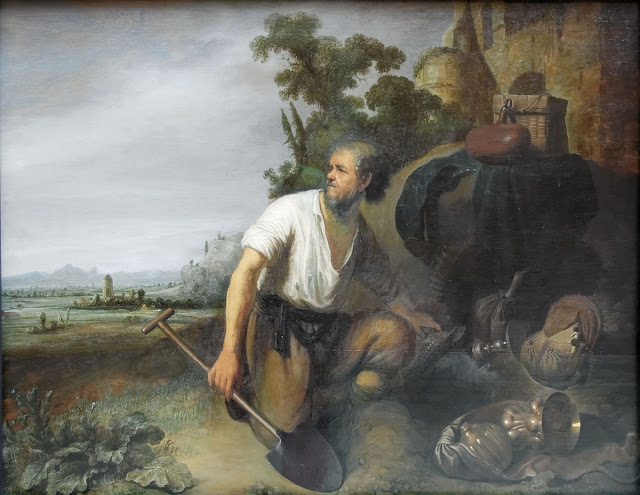
Parable of the hidden treasure by Rembrandt In a world where human effort often leads to success, it may be tempting to believe that eternal life can be achieved through our own endeavors. Just as we might work diligently to lift ourselves out of poverty, one might assume that eternal salvation can be earned through human effort alone. However, the teachings of the Church, the writings of saints, and Holy Scripture reveal a profound truth: eternal life is a divine gift that cannot be merited by human effort alone. Just as we cannot cure ourselves of disease without the guidance of a physician (Sirach 38:1-15), we cannot attain eternal life without cooperating with God's grace. This essay explores the nature of grace and its essential role in meriting eternal life, affirming that it is only through God’s grace that we can hope to achieve salvation. First, the necessity of grace is deeply rooted in the teachings of Thomas Aquinas, who asserted that “the free gift of God is eternal li...

Responsibility of Belief

Image
What do you believe? Would you know how to answer if I asked you a question about this or that aspect of your understanding of reality and its implications? If you did, would you be able to make it simple and say it with conviction? If the above questions made you somewhat uncomfortable, it would seem you have some investigation before you. The reality is most people in the West don’t have many strong convictions about what is true except murder is wrong and the dishes should be scraped before being put in the dishwasher. They can answer how to clean their house and how to do it, but when it comes to why one should go to church on Sunday, they just shrug their shoulders and say something like, “Gotta stay churched”. Atheists live what they believe, they know why they think they are right, and they will happily throw out what they perceive to be outside the bounds of what can be felt right without religion. Are Christians as diligent about what is true? Sadly, I think the closest thing ...

Philippians 3:7-11

Image
   Yet whatever gains I had, these I have come to regard as loss because of Christ. More than that, I regard everything as loss because of the surpassing value of knowing Christ Jesus my Lord. For his sake I have suffered the loss of all things, and I regard them as rubbish, in order that I may gain Christ and be found in him, not having a righteousness of my own that comes from the law, but one that comes through faith in Christ, the righteousness from God based on faith. I want to know Christ and the power of his resurrection and the sharing of his sufferings by becoming like him in his death, if somehow I may attain the resurrection from the dead. Many have called the Christian life difficult, and indeed, loving with everything we have is hardly described by “difficult”. Yet, this is the minimum expectation, since God’s grace affords us so much more than only our will can. The question remains, what is a fallen creature to do to make this happen at all times, in all circums...

Importance of Spiritual Direction

Image
"In addition, I cannot too strongly recommend that priests, consecrated persons and lay people who are skilled in this area should offer spiritual direction to young people so that they can review the different stages of their life under God's eyes, discern his presence and do his will, the source of profound freedom. Guidance by an adult whom the young person trusts will help him overcome the most difficult inner struggles, analyze his own conduct, make decisions according to a scale of values and enter into an ever closer relationship with Christ. Likewise, in drawing close to young people, adults are someone they can talk to and the witnesses they need in order to have a calm vision of their future as human beings and Christians. Thus young people will be able to listen with trust to Christ's call to put out into the deep (cf. Lk 5:4); they will dare to reveal their Christian identity and will be missionaries among their friends in a society where, as you say, faith ten...

Grace and Nature

Image
If you saw a close friend or family member held at gunpoint or overdosed on drugs in an ambulance, what is your first thought? In your finitude at such moments, you are loving with all your potentiality and trying to act beyond perhaps, how much more in God's Infinitude and Omnipotence does He do everything in His power to help those He died to save?   You may even be so bold as to discord to say, "would rather I have the addiction, or the gun pointed at me than them". If you think about the death and destruction that sin brings, it makes sense that God would give us some help. Is there anything, said person did to gain your love to this extent? Not likely except if it was your child, you likely love them more, at least have chosen to participate in a reproductive act that brought them life, more than this, God designed their soul to uphold and give expression to their matter that will give expression to the soul. It is the Catholic position that the gift of Christ's ...

The Seed of God

Image
We know that feeling after the best sleep we have had and needed for a while. Very little is quite as subliminal. We feel a restoration of what we were starving for. Thomas Merton is sometimes quoted as saying something to the effect of "being a contemplative is to be present to where God is creating oneself in the here and now". Although I am unsure of where exactly this quote originated, it draws us to contemplate just how true it is that God's work of creation is never done in us (perhaps in Heaven but maybe not). Christ, we find, is the Giver of Life always has been and always will be physically and spiritually. First, we know that "all things came into being through him, and without him, not one thing came into being. What has come into being in him was life, and the life was the light of all people." (John 1:3-4) Christ was there at the beginning and He is here now creating anew at the moment of every conception directly creating a soul, spiritual in the i...

Us and Stress

Image
Who are you when you are upset or when there is a great weight upon your shoulders? Is stress more likely to bring out our true personality, or distort the expression of our personality? This is the question we shall explore. Does God call us to overextend our strengths or simply develop them? We are made for peace, our hearts are finite and though sometimes we are tempted to be too concerned about something, we must remind ourselves why we act and whom ultimately it serves. No less stress and labor can be equivocal terms. Distress is “the negative stress response, often involving negative affect and physiological reactivity: a type of stress that results from being overwhelmed by demands, losses, or perceived threats.”[1] Distress is more likely to bring out our will to survive, whether on the physical level or the psychological level. Distress would amplify such effects over other aspects of our personality and thus who we are in that moment is distorted not just who we seem to be. D...

Growing the Human Way

Image
You have likely heard about new year's resolutions or lent fast, and with these terms, you have probably also heard talk of difficulties and (ironically) a lack of resolve. After all, we know not what a struggle is until we have tried to improve our habits, impeding the bad ones and giving life to the better ones (to supplant bad ones), which never ceases to challenge our willpower. Indeed, throughout the whole of our lives, we have been growing, if we act like heaven is a real possibility, we are thus motivated to be with our Eternal Spouse. Even where proximate ends are concerned, we will not be truly happy until we renounce all but God. Thus, we seek to make use of and often require extrinsic forces to ourselves to make growth in ways we direly need possible.  Vygotsky’s concept of the scaffold is significant in understanding what it takes to grow i.e. the generosity of others. This “scaffold” refers to any assistive force that allows one to move to the next psychological and kn...

Lamb of God: a title of great import

Image
" Ecce agnus Dei, ecce qui tollit peccatum mundi " “Behold, the Lamb of God, who takes away the sin of the world! This is he of whom I said, ‘After me comes to a man who ranks before me, for he was before me.’"John 1:29-30 How was reconciliation made possible? How was it possible for God (Jesus) to die? These questions are answered in the sacramental economy and in the title that John the Baptist gave to Jesus, in light of previous scriptures.[1] The former is also answered in the latter since it is this single bloody sacrifice accomplished "once, for all" that was made possible through the Baptism Jesus received in solidarity with us. Thus Baptism formed the sacramental (uniting Christ to sinners and thus making His divine mortality possible) and the Paschal mystery gave it life. Christ's Messianic role of becoming the Divine Lamb to be sacrificed reverberates throughout Sacred Scripture and gave life to Sacred Tradition.  In Genesis 22, God provided a ram...

What motivates you?

Image
A common interview question is “What makes you get out of bed in the morning?”. This question is very important because it is how the interviewer determines what kind of work ethic we have and what source it has. Every act requires motivation. Motivations come from many places whether it is the pursuit of a long-term good that we are after a greater good than can be attained in the present or the pursuit of a short-term good which are often fleeting and don’t require much effort. Pain and pleasure are good motivators because without them we would walk on our broken leg or not have reason to pursue goals. We are all protagonists in our own story, and consequently, what we consider good may not be in our best interest nor those of others. There is one motivator that cannot fail, which joins all people together, which operates in the face of pain and the absence of pleasure, and which does not require a specific long-term or short-term end i.e. love. Love as we define it knows no limits ...

Final Part in Relationship with God: Union

Image
The last phase and goal of conversion is union. This phase is one in which our enemies lose their power over us. In the prior phases [ 1 ][ 2 ], and most viciously in the previous one, our enemies fight with great strength to prevent our coming to this state. As we reflect on the battle that is the Christian life, it is not like our enemies stop trying but it is that they begin losing effect, potency, control over us. At this moment in our relationship with God, our longing finds its path toward infinity, our love for others becomes boundless, God becomes our spouse , and we become living landmarks of the kingdom. If you have ever been attached to something, you understand the unsatisfiable desire for more. When falling in love with God and beginning to live out of our spiritual marriage, we do not find our longing for God quenched but exponentially increased. Marriage is a physical sign of spiritual grace . However, this spiritual marriage lacks a physical dimension without the sacram...

Love is Somewhat Important

Image
As I study Medieval Philosophy and the application of philosophy in life in general, but also theology; I am struck by a truth that subordinates all human activity to one thing, love.  The most essential human ability is to love, the rest of our being act in accord with this purpose insofar as they are used for authentic and whole love. No human preoccupation is greater than love, and other human activities are acting in accord with their highest purpose and God's will insofar as they move all they involve to greater love. In love, we were created, are called, are given meaning, are rightly ordered, and we are rightly destined. God is good and infinitely so. Goodness by nature is self-diffusive. God being good, created all things in this goodness, to reflect this goodness, and only by reason of His goodness. God does not need what He created and even with the reality of sin is more prone to lose what He loves. God, to love, must necessarily allow for the possibility of evil, becaus...

The Journey of the Mind to God

Image
In man's encounter with the outside world, there is sort of a natural assumption that something transcendent exists, and in some strange way affects what we can sense. From the beginning of recorded history, there has always been a notion that something exists beyond what can be empirically sensed/studied[1]. An atheistic perspective would conclude that the is the result of overly simplistic conclusions which make further investigation seems futile. However, in a sort of irony, one could say the same about that assertion. In fact, it is captivating how much we can know about the created universe i.e. trajectories, densities, atomic structures, and the like are all computable because they always follow set "laws" of existence. When one encounters what is exterior to oneself to the point of knowledge there seems to be a consistent entity behind it all. Our mind zealously marches on a certain path toward the deepest knowledge of reality. The (1) senses and (2) imagination ar...